

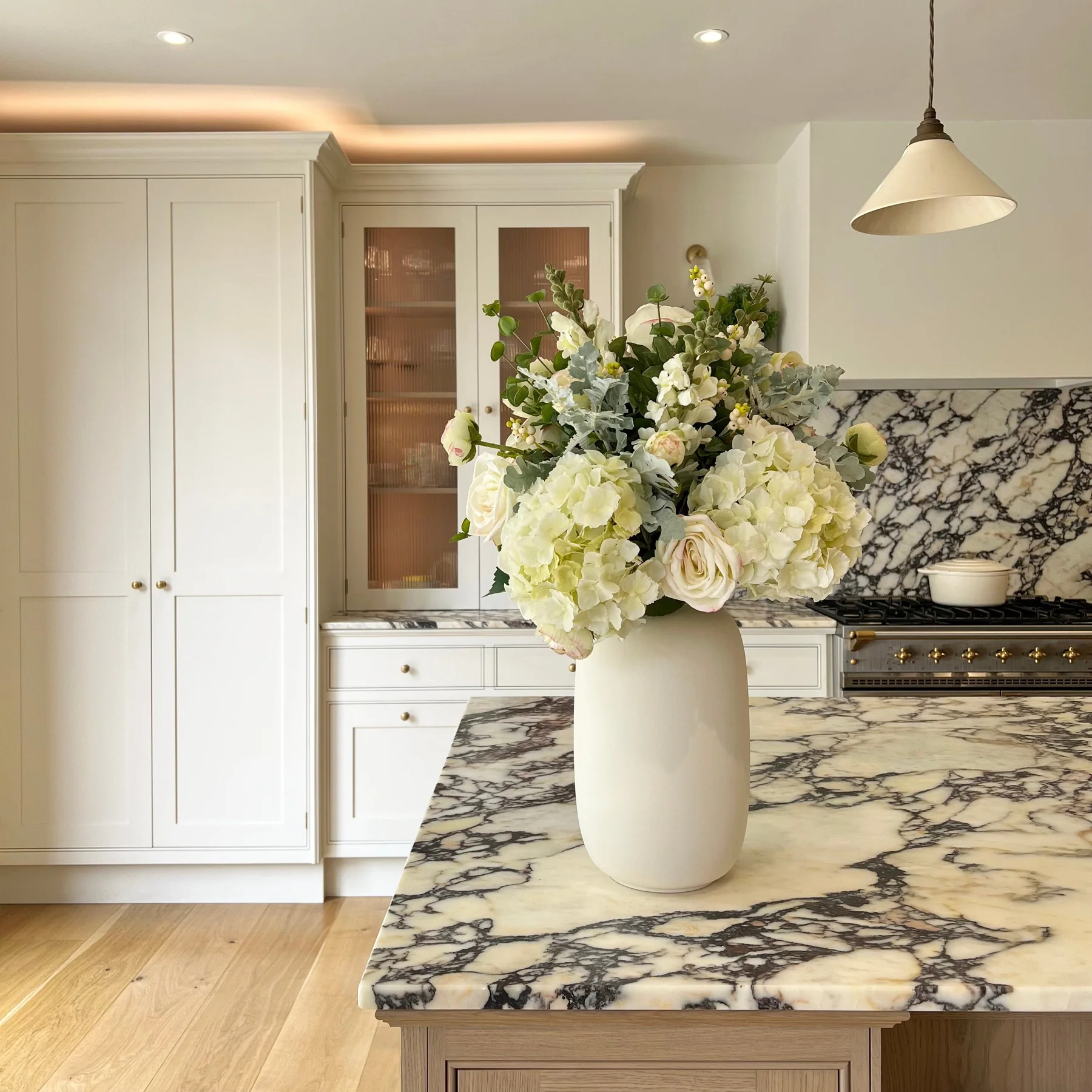
New market analysis shows artificial flowers now command 14.3% of the UK’s £2.2 billion retail flower market, with growth rates significantly outpacing fresh flowers as quality improvements and environmental considerations reshape specification decisions.
Research published by The Faux Flower Company, which appeared in Retail Insider, cross-referenced data from Grand View Research, IBISWorld, and UK government statistics to reveal the artificial flower market reached £314.7 million in 2023. The analysis projects growth to 17.5% market share by 2030, with artificial flowers growing at 4.8% annually compared to fresh flowers’ 0.6% decline.
“We’re seeing interior designers who previously wouldn’t consider faux flowers now specifying them for client projects because the quality has reached a point where they enhance rather than compromise a design scheme,” said Rachel Dunn, Head of Product at The Faux Flower Company.
The commercial sector is driving substantial volume, with hotels, restaurants, and corporate offices increasingly favouring artificial arrangements. Fresh flowers in commercial settings require replacement every 7-12 days, translating to 30-50 replacements annually per location. The research shows artificial arrangements eliminate the price volatility inherent to fresh flowers, which lose 15% of their value for each additional day in transit.

Environmental factors are also influencing specification decisions. Life cycle analysis data compiled by Lancaster University researchers shows Dutch greenhouse roses generate 1.8-2.4 kg CO2e per stem. A standard 12-stem arrangement creates 21.6-28.8 kg of carbon emissions. For projects pursuing BREEAM certification or net-zero targets, the longevity of artificial arrangements may align better with sustainability goals than frequent fresh flower replacement cycles.
83.5% of fresh flowers sold in the UK are sourced from overseas, primarily the Netherlands, creating vulnerability to supply disruptions. Post-Brexit border controls implemented in April 2024 added 5% to import costs according to Dutch exporters, making price stability an increasingly attractive factor for designers working on long-term contracts.

Material innovations in silk, latex, and polyethylene blends have enhanced realism in artificial flowers, with the global market projected to reach $4.49 billion by 2030. For residential projects where clients previously rejected artificial options on aesthetic grounds, manufacturing advances create new specification possibilities that maintain design integrity.